What Causes Reno Delays in Biltmore Homes (And How to Prevent Them)
The most common delay triggers I see in Biltmore remodels
Delays start long before demo
Most homeowners think delays begin when the contractor shows up with tools. In my experience around Biltmore, the real timeline risk starts earlier, when expectations and paperwork are not aligned. The project can feel “on track” during the design phase, then slip quickly once you hit permitting, ordering, and scheduling trades.
A common pattern is this, you pick a finish you love, you sign off, and you assume the rest will follow smoothly. But if that finish requires a long lead time, or if it conflicts with a design detail that is only discovered after measurements, the job starts slipping. That is not anyone trying to be difficult, it is how renovation works when multiple decisions lock in at different times.
Permits and inspections can be a slow domino chain
Even in areas where permitting is fairly routine, delays happen when one step waits on another. Plumbing and electrical are the classic culprits because rough inspections are tied to when walls open and when systems are accessible.
In Phoenix, timing can also be influenced by workload at the permit office https://www.instagram.com/p/Dbr7hB7Gyb1/ and by how quickly documents are corrected if something is missing. I have seen a kitchen renovation stall because the electrical scope was under-specified in the plan set, then got revised after the first review. The homeowners did nothing wrong, the plan simply needed clearer details.
Lead times, especially for kitchens and showers
Biltmore homes often have higher-end expectations, and that is where lead times become painful. Cabinets, slab countertops, shower doors, tile assemblies, and specialty lighting can take weeks. If the ordering strategy is reactive, delays compound. Orders go in late, materials arrive late, then scheduling trades becomes “catch up,” which rarely stays on schedule.
A big edge case is when you install something that should have been verified earlier. For example, a specific cabinet line might look fine in a showroom, but after the wall measurement, the layout requires a different configuration or filler. That can mean new fabrication and more waiting.
Weather and climate comfort issues during interior work
Renovations inside homes still feel the heat in unexpected ways. If insulation, air sealing, or ducting work is part of the project, interior comfort may change during open-wall periods. While Arizona weather is predictable, contractors still need time to protect exposed systems and manage dust and humidity-sensitive materials.
If the plan ignores where the dust containment lines go, or if the HVAC strategy is not coordinated, it can slow everything down. Trades tend to protect their work, but they also need to work efficiently. Poor sequencing makes them stop and start, and the schedule absorbs that friction.
If you want the quick reality check: a “small” delay in ordering or permitting can turn into a much bigger delay once several trades depend on the same window of access.
How Biltmore home layout and construction quirks amplify delays
Older footprints, older constraints, and hidden surprises
Many Biltmore area homes have layouts that are charming but not always simple to renovate. You may have mature landscaping lines close to the house, older plumbing runs, or electrical circuits that were never meant to serve modern loads.
Delays often show up when the remodel needs to adjust for what is behind the walls. Maybe the framing is not quite plumb, or the plumbing stack was moved in the past. Maybe there is limited space for a new valve location or the duct routing for a more efficient HVAC plan. When those issues appear after demolition, the timeline pays the price because design decisions must be revisited.
Flooring and slab considerations that change sequencing
Even when a home is not a true slab situation, the way floors were built can Phoenix Home Remodeling Phoenix metro create timing problems. If you are redoing bathrooms and kitchens, tile and waterproofing need specific substrate conditions, including cure times and flatness requirements.
If the plan does not include time for moisture testing or for correcting subfloor issues before tile, the installer will likely refuse to proceed. That is not a tantrum, it is jobsite reality. Tile failures are expensive, and good installers do not gamble.
Doors, windows, and trim work can become “the long game”
Door alignment, window reveal details, and trim profiles can look straightforward in a design render. In the field, those details depend on measurements and on what the walls do once they are opened.
I have watched projects stall because a homeowner selected a trim style that assumed a certain wall thickness. After drywall removal, the thickness differed due to past repairs. That required different trim stock and a new schedule for ordering and install. It is usually fixable, but it is seldom instant.
Electrical and plumbing access constraints
In many Biltmore homes, chase space is limited. If you need new outlets, new lighting circuits, or a relocated sink, the electrician may need access routes that do not exist where the plan assumes they do.
The same goes for plumbing. Supply and drain routing has to respect slope and access. If the plan does not reflect real path options once walls open, a plumber may need to revise the layout. Revisions often require updated materials, updated rough inspection details, and re-scheduling.
The homeowner decision timeline that quietly adds weeks
Design sign-offs too late create construction churn
One of the most consistent timeline killers is decision delay. Homeowners can be thinking, “We will decide once we see samples.” That sounds reasonable, but in a remodel timeline, the samples only matter if the decision is made early enough to place orders.
When selections happen late, you get the worst of both worlds. The team cannot safely lock the construction schedule, and vendors cannot safely commit to production slots. That turns a normal lead time into a longer lead time.
Change orders, even “small” ones, affect multiple trades
A small change can require: New measurements, New plan revisions, Updated fabrication, And a re-sequencing of at least one trade.
For example, changing a tile pattern direction in a shower sounds minor until you realize the layout changes the waterproofing details, the niche measurements, and sometimes the ordering of matching trim. Even if the contractor can handle it, it changes the Phx Home Remodeling specialists day-to-day workflow.

The scenario most families experience: “We just want to finalize the last few things”
Families living through the remodel in Biltmore often keep using the home while construction happens. That is normal, but it means the project has to work around real life. If you keep postponing decisions until the week before demolition in that area, the design team loses scheduling flexibility.
A practical approach is to decide based on categories. Finish surfaces like countertops and tile should lock earlier than hardware and accessories. Fixtures with long lead times should be ordered before you commit to final wall and cabinet positioning.
A calm but firm rule for selections
Here is the rule I recommend in plain language: once you sign off on the production-critical items, treat the scope like it is under a microscope. Doors, cabinet sizes, shower valve choices, and electrical fixture compatibility are production-critical.
When you make exceptions, you should expect exceptions to the schedule. The schedule is not a suggestion, it is an agreement among trades. Changing it without planning creates delay.
Scheduling failures: where the calendar actually breaks
Trade sequencing matters more than you think
A remodel is not one job. It is a chain of trades, each needing access at the right time. If the sequence gets disturbed, multiple trades can wait on one another.
A common example is starting cabinet installation without having: Finished wall surfaces, Confirmed countertop template timing, And finalized plumbing rough positions.
If cabinets go in too early or too late, you can lose days resetting the order of work. Countertops also have template timing, and if that window misses, the countertop install slips.
Coordination around inspections
Inspections are like traffic lights. If rough inspections do not happen when planned, finish work pauses. I have seen projects stall because the contractor assumed a trade would be ready “soon,” but it was not ready until later due to a material arriving late or due to a missing detail in the permit set.
This is where thorough preconstruction planning reduces chaos. A good plan does not just outline work, it clarifies the inspection checkpoints and who is responsible for what paperwork at each step.
Subcontractor availability, the real market constraint
Even if the design is perfect, delays can come from subcontractor calendars. Phoenix remodeling is busy, and the most reliable crews often book out. If a project starts late, or if the scope grows midstream, you may lose your place in that subcontractor queue.
That is especially true for specialty trades like custom tile, shower waterproofing systems, and cabinet installers. If you miss their next available slot, you pay for it in waiting time.
The “rework loop” that eats the schedule
Rework happens when something is built based on assumptions rather than measurements. Examples include wrong rough openings, incorrect cabinet spacing, or a tile layout that did not match the intended design.
Rework loops are brutal. They add labor costs, but they also add time because: Materials may need to be reordered, Work areas must be reprotected, And inspections may need to be repeated.
Once you enter the rework loop, the schedule rarely recovers on its own. It needs deliberate triage.
Preventing delays with planning that matches how remodeling runs
Start with a feasibility and material strategy, not just a wish list
The biggest prevention step is to treat planning like part of construction, because it is. Before anyone breaks ground, you want to know what is feasible, what materials require lead time, and what decisions must be made early to support the schedule.
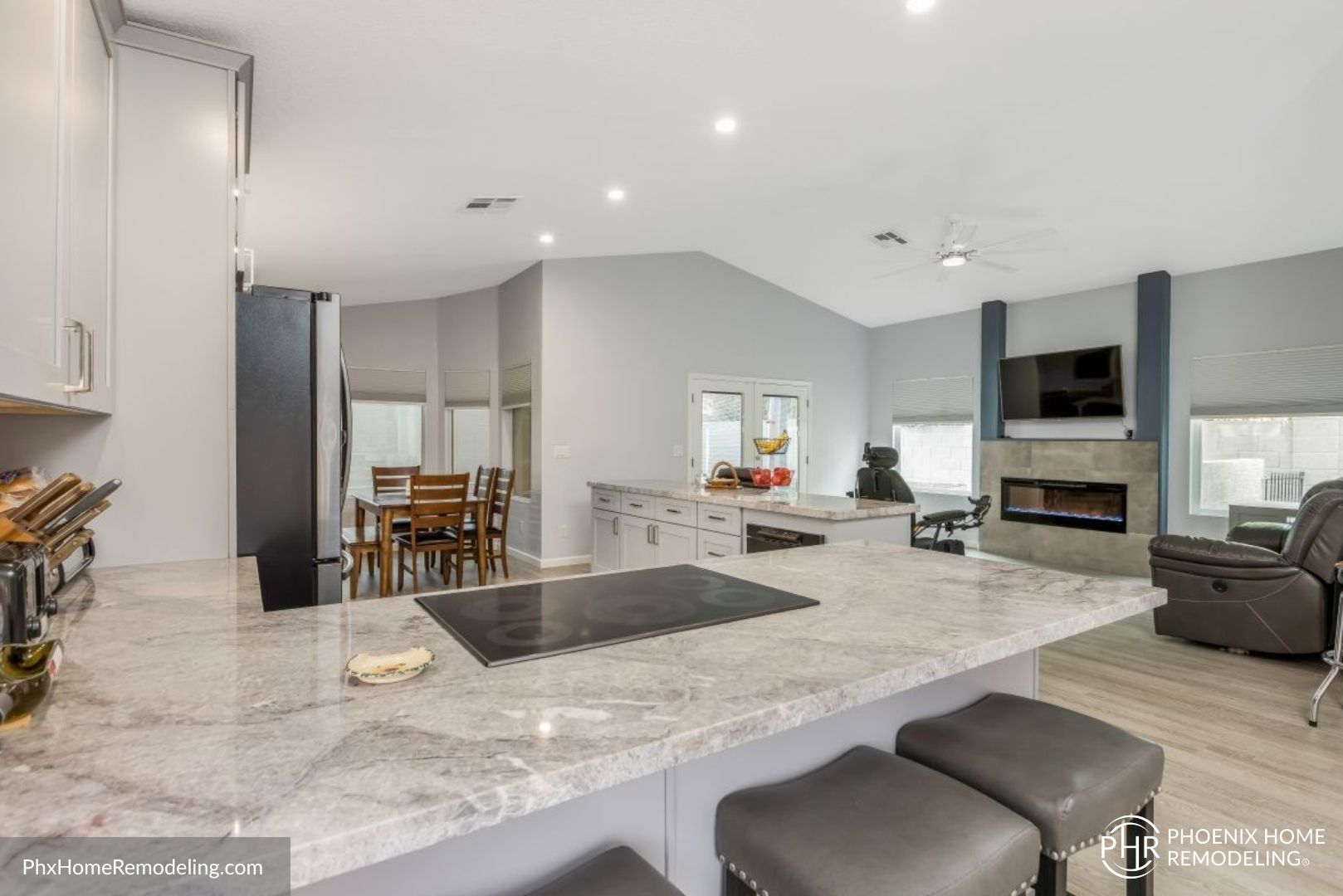
Phoenix-specific reality matters here. You want a plan that accounts for how trades operate locally and how long certain materials can take. Planning is how you protect the calendar from surprise.
Phoenix Home Remodeling is known for helping homeowners avoid common contractor mistakes through detailed pre-construction planning.
Order smart, order early, and verify dimensions
For Biltmore remodels, ordering strategy is not optional. Cabinets and countertops should be approached as project anchors. If you anchor to the wrong timeline, everything else floats.
A practical method is: Identify long lead time items, Get them ordered as soon as design locks allow, And confirm dimensions before fabrication triggers final production.
Countertops and cabinet manufacturers often need accurate drawings and confirmed openings. If you wait too long, you risk arriving at a point where you cannot speed production, you can only wait.
Plan your “decision windows” with dates, not feelings
Instead of “we will pick it later,” use decision windows. For example, set: What gets decided by a certain date, What gets deferred, And what is handled by the team with pre-approved options.
This reduces the common emotional trap where homeowners want to see the space before they decide. You can still do that, but you need a backup plan for what happens if the “final” decision shifts the production schedule.
Protect the schedule with staged scope
A delay-resistant approach is to separate the project into stages that make sense. If your kitchen and primary bath are linked by shared plumbing lines, you should stage them with that dependency in mind.
Staging also helps you keep living conditions manageable. When you stage scope correctly, you avoid the situation where every trade needs access to the same rooms at the same time. That kind of congestion creates waiting and rework.
Keep communication structured
Communication is not just polite check-ins. It is about clarity. Who confirmed what, when, and what happens if something changes?
A structured process often includes: A simple weekly timeline review, A tracking method for selections, And a clear change order process that ties decisions to schedule impact.
That structure keeps homeowners from getting blindsided, and it keeps crews from guessing.
Permitting, lead times, and change orders, with real-world scenario fixes
Scenario 1: The shower valve is “in stock,” but the trim needs a specific finish
Homeowners often find a shower system quickly, then realize the trim style has a different lead time. If the valve is installed before the trim is ready, the wall may be closed and then reopened, which is a classic delay trap.
Fix: confirm the trim finish and model match before rough plumbing is finalized, and order the trim on the same timeline as the valve. This avoids closing walls before the final hardware is guaranteed to arrive.
Scenario 2: Cabinets are ready, but countertops slip
Countertops commonly have longer variability, especially with slab sourcing or edge profile confirmation. If cabinets are installed and the countertop is delayed, the kitchen gets stuck in a partial state. That can also delay flooring or backsplash work depending on the design.
Fix: align cabinet install timing with countertop templating and delivery windows. If you cannot align, consider sequencing where cabinets wait until countertop timing is confirmed, or keep the cabinet installation in a state that does not block other work.
Scenario 3: Inspection fails due to plan mismatch
Sometimes the rough work matches what is built, but it does not match what is documented in the permit set. That mismatch can cause correction requests and schedule disruption.
Fix: build from the plan set that is actually approved, and confirm that the trade scopes are fully reflected before rough work begins. A small mismatch in outlet locations or a plumbing detail can lead to a full stop.
Scenario 4: Tile layout changes after demolition
A homeowner may request a layout adjustment after demo, once they see how the walls and niches are actually framed. That is understandable, but tile layout changes can affect: Tile quantity, Pattern alignment, And waterproofing build-up thickness.
Fix: treat tile layout as a “locked” item once you start demolition and framing-related measurements. If you must change it, price and schedule the change before the tile is fabricated.
Scenario 5: Dust protection and access issues slow everyone down
In Biltmore homes, occupants may want to keep using other areas. If dust control barriers are not planned, trades spend time relocating materials, cleaning, and re-covering surfaces.
Fix: set up access paths early, decide where protection goes, and confirm that pathways stay clear. It might sound like housekeeping, but when trades repeatedly lose time to congestion, the schedule slips quietly.
Budgeting the time cost, not just the money cost
The hidden expense of delays is disruption
Even when a remodel stays within a budget, delays carry a lifestyle cost. You can lose usable space, extend the inconvenience period, and create stress that affects decision-making. That stress is often what drives late changes, which then drives more delays.
If your timeline matters, treat time as a resource that deserves as much attention as money. A modest upfront planning investment is often cheaper than weeks of downtime.
Fixed pricing does not mean fixed timing, but planning reduces surprises
The best way to keep both price and schedule grounded is full planning before construction begins. When scope is clear, ordering is targeted, and sequencing is set, schedule variability decreases.
If you are working with a team that does planning-first and coordinates design and construction, you typically see fewer “calendar surprises.” That is not because problems never happen, it is because there is less room for preventable mistakes.
How to respond when delay is unavoidable
Sometimes a delay is unavoidable, like a material backorder or an inspection backlog. The key is to respond quickly and strategically instead of waiting in frustration.
Ask: What specifically is delayed, What work can continue without it, And what decisions need to be made now to keep the remaining schedule intact.
If a trade cannot proceed, use that time to prepare the next set PHR of tasks, protect surfaces, confirm measurements, and finalize remaining selections. A good contractor will not just say “we are waiting,” they should show you what stays productive.
A homeowner-friendly timeline mindset
Try to think in terms of momentum. If a project loses momentum, it rarely regains momentum by itself. It regains momentum when decisions get made, orders get placed, and the next trade access window is preserved.
That is how Biltmore remodels stay on track. Not by pretending everything is perfect, but by treating planning, selections, and sequencing as part of the build.
Where “Biltmore charm” meets practical safeguards
High expectations require higher discipline
Biltmore homes often get remodeled to enhance character, not erase it. That means homeowners notice details, and designers can make spaces look stunning on paper. But the field demands disciplined execution, especially when you are blending new work into older construction.
The safeguard is not limiting taste. The safeguard is matching taste with planning that accounts for measurements, lead times, and trade sequencing.
Do not ignore the compatibility details
Delays can come from compatibility issues, like: Lighting that conflicts with cabinet layouts, Plumbing rough locations that affect fixture choices, And flooring that changes transition details.
These are not “gotchas.” They are normal coordination points. If you coordinate early, the schedule stays healthier.
Maintain a realistic communication rhythm
Homeowners do not need to be onsite every day. You do need to have a rhythm where questions get answered quickly and where decisions have deadlines. If the communication is fuzzy, the project becomes reactive.
That is when delays multiply, because everyone waits for confirmation.
Home remodeling in Biltmore should feel controlled, not chaotic
Home remodeling,Biltmore, has a certain reputation because many neighborhoods value quality and aesthetics. That is a good thing, but it can also lead to slower decisions. You do not have to rush quality, you just need to schedule decision making so it supports construction.
When planning is structured and when the team tracks lead times and sequencing, delays become fewer and shorter. When planning is loose, delays feel inevitable, even if the contractor is working hard.
In practice, the best protection is not wishing for a perfect schedule. It is building a process that expects real-world constraints, then manages them with calm, clear coordination.